Hope For The Healing Of The Nations
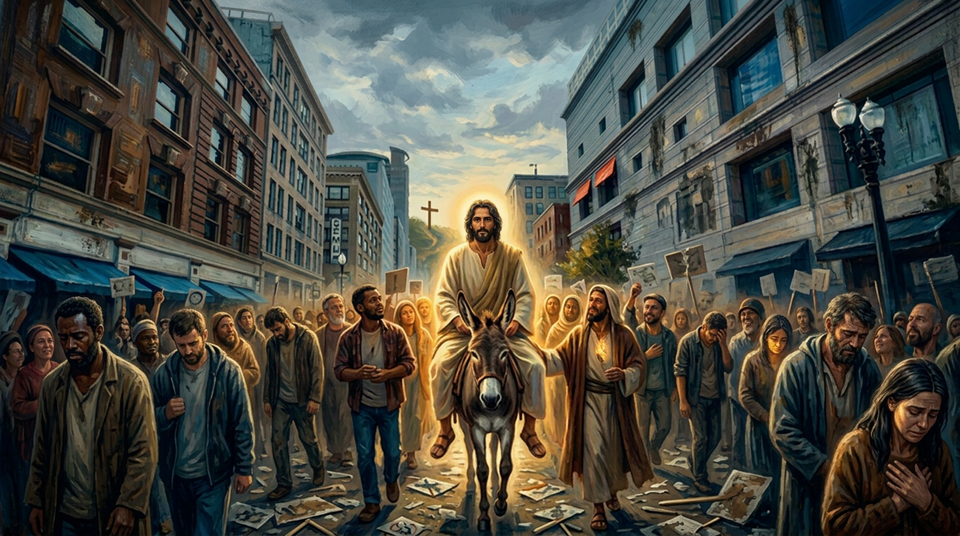
There has always been a tension inside the Christian imagination, a kind of ache between our human longings for political liberation now and the Kingdom Jesus actually inaugurated.
This tension isn't new.
It didn't begin with modern activism or with American politics, or with the current struggle between Christian nationalism and faith-based resistance.
It's older than all of that.
You can feel it already in the Gospels, humming beneath the surface, and it becomes unmistakably visible the moment Jesus rides into Jerusalem on a donkey (Matt 21:1-11).
He had been anticipating it all along, keeping a low profile throughout His ministry because He knew how easily crowds would confuse His mission with political revolution. The prophets had already spoken of a Messiah who would not cry out in the streets or stir up public frenzy, and the Gospels show Him repeatedly withdrawing from crowds to prevent escalation (Isa 42:2-3; Matt 12:15-21, John 6:15, John 7:1-10, Mark 1:43-45, Mark 3:7-12). He also carried a deep awareness of how quickly Rome crushed uprisings, and He would not allow the vulnerable to be swept into the violence of an insurrection. His restraint was not fear – it was protection. He later grieved that the people rejected His gentle peacemaking posture and expressed His longing as He wept over the way the city of Jerusalem would face coming destruction due to failed revolts (Luke 19:41-44).
As Jesus rides in, what we see in that prophetic and processional moment is the collision of two very different hopes: the human longing for immediate political change and the deeper, slower, more healing Kingdom Jesus came to bring.
The word Hosanna is a transliteration of the Hebrew hoshia-na—“save us now, we pray.” It comes from Psalm 118, a psalm sung during Israel’s great festivals of liberation. It was not a metaphor. It was a plea for divine intervention in real history. And in the first century, salvation meant something painfully concrete:
Deliver us from Rome.
Break the yoke of oppression.
Restore our nation.
This was not abstract spirituality.
It was survival.
And Jesus did not silence it.
He let the cry rise.
He let the longing be heard.
He let the oppressed speak their hope.
And the palm branches they waved were not merely decorations. They were reenacting a revolution. During the Maccabean Revolt, Jewish rebels defeated the Seleucid military presence in Judea, liberated the Temple, and reclaimed religious independence. The people celebrated with palm branches. From that moment on, palms meant military victory, national liberation, the overthrow of foreign occupiers. So when the crowds waved palms at Jesus, they were saying:
Do it again!
Be our liberator!
Drive out Rome!
We beg you …
We are desperate …
Their longing was real. Their suffering was real. Their hope was real. And Jesus did not shame them for it.
He understood their helpless misery. They were being harassed by military brutality, heavy taxation, and religious oppression. But the expectations they held of Him in that cultural historical moment–the political deliverance they were ready to erupt into—He did not satisfy. Rather He gently redirected them.
The donkey was a powerful de-escalating image. If He had come in on a warhorse, the crowd would have surged around Him in an instant. But this “triumphal entry"? This was not a calculated political maneuver. It was a quiet sign, almost a whisper, that His Kingdom moved differently. Because with Jesus, there are no tactics. Just truth and love. He is simply expressing who He is: humble, meek, gentle, and powerful all at once.
Still, because the public frenzy was rising, the religious leaders demanded that He silence the people.
He refused: “If they keep silent, even the stones will cry out,” He said—the groaning of creation itself under injustice.
Jesus validated their longing.
He honored their ache.
He even blessed it.
“Blessed are you who hunger and thirst for righteousness (the Greek word is dikaiosynē) for you will be filled" (Matt 5:6).
That Greek word dikaiosynē is drawing directly from the Hebrew world of tzedakah (restorative justice, right relationship, fairness that heals), mishpat (judgment that sets things right), and mitzvah (the doing of covenantal good).
Jesus understood exactly what the crowd wanted.
But He also refused to organize them, weaponize them, direct them, leverage them, or turn them into a political force.
Do you feel the tension? Let it form because it is real and fueling much of our civic discourse today. Christians are wrestling with what it means to live out our faith publicly, expressing what Christ is forming in us, while holding the tension Jesus named between Kingdom transformation and political change.
Political organizers depend on mobilizing crowds. They've even turned it into a science. Research shows that nonviolent movements are twice as effective as violent ones, succeeding about 52% of the time. Even more striking, history shows that if you can mobilize just 3.5% of the population in sustained resistance, then political victory becomes historically inevitable (Erica Chenoweth & Maria J. Stephan, Why Civil Resistance Works, 2011).
Yet Jesus doesn't offer us a 3.5% strategy. He offers His covenantal faithfulness. Not because He doesn't care, but because He cares too much to let us settle for quick fixes that compromise integrity. The hope He offers is for the ages and builds towards universal restoration of all things. If Jesus wanted to lead a quick political uprising, then He would have ridden a warhorse. Instead, He was a servant leader, not “lording it over others". He was fulfilling Zechariah’s vision of a king who proclaims peace to the nations (Zechariah 9:9–10). This is the slow mustard seed growth that requires enemy love, long suffering, and the nurturing patience of a gardener.
He was saying: Yes, I am the King you're crying out for. But the salvation I bring is deeper than the one you're imagining. I refuse to become the kind of king the world wants. But I am the kind of King the world needs.
This is not meant to dishearten the workers in the field—those who devote their lives to advocacy for the lowly and forgotten, or the civil servants and policymakers doing critical work every day for those with scarce resources. Jesus is not indifferent to injustice. He is not passive about oppression. He is not neutral about suffering. But He offers something deeper than legislation, political reform, mass movements, national liberation, or fifty-two percent chances. He offers the Bread of Life, living water, communion with God, reconciliation, new creation, agape love, and resurrection life—a Kingdom that cannot be shaken. This is the universal restoration Peter speaks of in Acts, and the healing of the nations John sees in Revelation. This is the horizon of Christian hope.
Even after the resurrection, the disciples still wanted political liberation. They asked, “Lord, will you at this time restore the kingdom to Israel?” And Jesus answered with such gentleness: “It is not for you to know the times or seasons the Father has set.”
He doesn't shame the question. He doesn't condemn the longing. He doesn't silence the hope. He simply redirects it.
“What is happening now,” Jesus says, “is something different: you will receive power when the Holy Spirit comes upon you, and you will be my witnesses.”
Not political power.
Not mass mobilization.
Not national restoration.
Not overthrowing empire.
But Spirit power—the power to embody Christ in the world.
This is the yeast-through-the-dough Kingdom Jesus describes: slow, hidden, relational, patient, transformative—unstoppable. This is the Kingdom that grows quietly, deeply, faithfully—not through crowds, but through hearts.
And Jesus protects His sheep from smaller hopes. Scripture reminds us that He will lose none of those the Father has given Him, that no one will snatch them out of His hand, and that He actively prays, “Holy Father, keep them in Your name” (John 6:39, 10:28, 17:11).
You are being guarded by God's power. He is able to keep you from stumbling. Jesus guards His people from false liberations, false hopes, false messiahs, false kingdoms, false salvations. He guards us so that we don't mistake activism for salvation, political reform for Kingdom restoration, human solidarity for agape, temporary liberation for eternal healing. He guards us so that our hope remains in Christ alone.
Then, Revelation gives us the most beautiful completion of this story. John sees a great multitude that no one can count, from every nation, tribe, people, and language, standing before the Lamb with palm branches in their hands (Revelation 7:9–10). The same symbol that once signified Jewish national liberation is now transformed into a symbol of universal restoration. The Hosanna cry that once rose from one oppressed people now rises from all peoples: salvation belongs to our God and to the Lamb. This is the Kingdom Jesus refused to shrink into a political uprising. This is the liberation He was bringing all along—not the victory of one nation, but the healing of the nations.
To my brothers and sisters who hunger for justice—I see you. Jesus sees you.
Your longing is holy.
Your grief is real.
Your desire to protect the vulnerable is the heartbeat of God.
Jesus did not silence the cries of Hosanna. He will not silence yours. But He does redirect them. He does not want you to settle for a hope that depends on probability, or to trade the power of resurrection for the power of numbers. He does not want you to confuse political mobilization with Kingdom transformation, or to forget the Kingdom that cannot be shaken.
Hosanna is still our prayer. “Save us now.”
But the salvation we seek comes not from crowd mobilization, legislative majorities, or fifty-two percent chances. It comes from the One who rode a donkey, who refused the warhorse, who redefined victory, who conquered death, and who will never put us to shame.
Member discussion