Not Silence But Spirit: Why the Church as Prophetic Witness Must Name Christian Nationalism
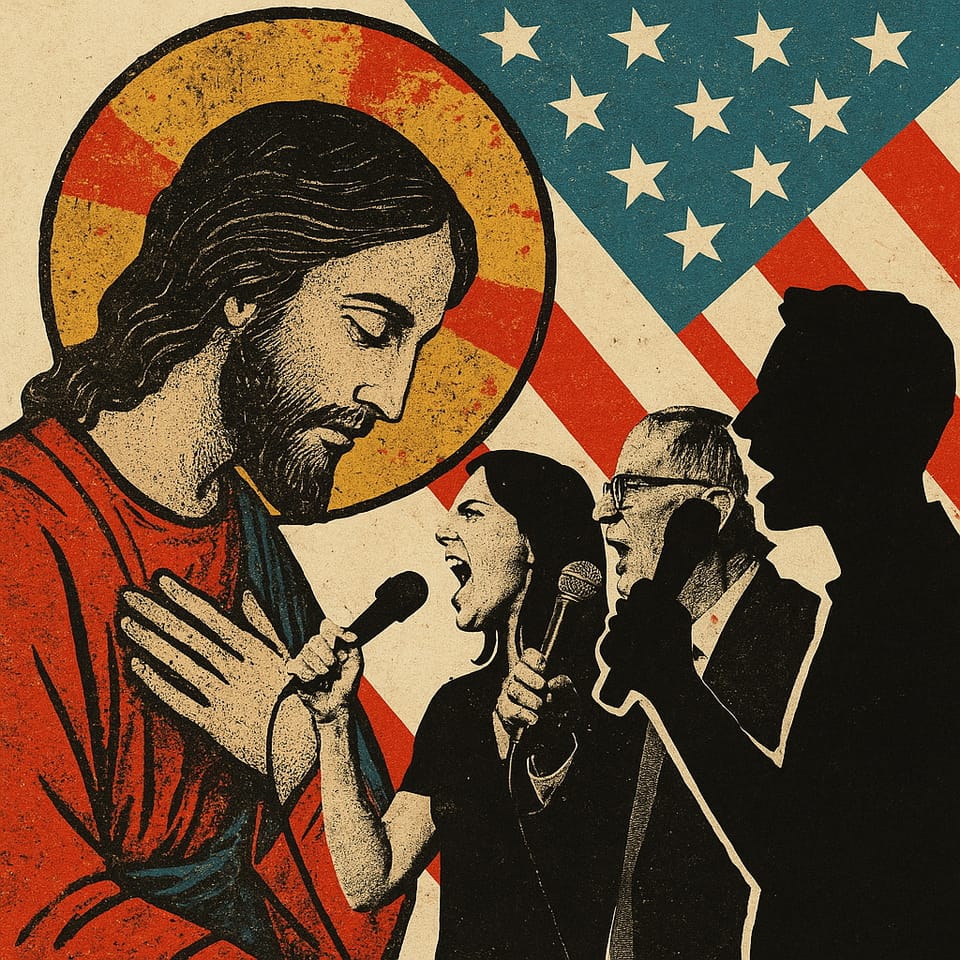
There is a deep ache rising in the church—and a hopeful conviction that prophetic witness must not be silenced. Across the country, I’ve seen Christian leaders urge unity—particularly in the wake of ongoing political polarization and social unrest. Campaigns such as the "31 Days of Unity" in October 2024 gathered pastors from across the theological spectrum to promote harmony over division, urging Christians to reject polarizing rhetoric and "embrace the unifying presence of Christ" (Religion News Service, Sept. 2024). Similarly, following the 2024 presidential election, the U.S. Conference of Catholic Bishops issued a statement calling for prayer and unity in a time of national tension (Angelus News, Nov. 2024). While these appeals are understandable and well-intentioned, they can unintentionally imply that public critique or prophetic speech is a threat to unity rather than an expression of faithfulness. But the gospel I know—the one I read in scripture, and see echoed in history—calls us not only to personal transformation, but also to public faithfulness.
It is true that the Holy Spirit convicts the world of sin. But scripture shows, again and again, that the Spirit often does so through human voices.
Through Nathan, the prophet who confronted King David not out of self-righteousness but out of fidelity to truth. Through Isaiah and Jeremiah, who named injustice, oppression, and the failure of leaders as part of God's movement toward restoration. Through Jesus, who did not shy away from rebuking hypocrisy and exclusion, especially among the religious elite. Through Paul, who called out Peter publicly when Peter’s behavior harmed the early church's witness of inclusion (Galatians 2:11).
Even the verse in Galatians 6:1, "you who are spiritual should restore such a one in a spirit of gentleness," assumes a kind of love that does not stay silent. It restores through truth, relationship, and grace.
The great cloud of witnesses did not retreat to private rooms. Martin Luther did not keep silent about corruption in the Church—and the very existence of the Evangelical tradition is rooted in that act of Spirit-led confrontation. Without Luther’s willingness to call out injustice within his own faith community, we likely wouldn’t have the tradition that now sometimes discourages such critique. That irony is not lost on me.
Nor can I forget Oscar Romero, the Salvadoran archbishop who began as a quiet and conservative leader, but who, after witnessing the suffering of the poor and the murder of his friend, found his voice. He preached boldly against violence, inequality, and oppression. In his book The Scandal of Redemption, he wrote: "That is what the Church wants: to disturb people’s consciences and to provoke a crisis in their lives. A church that does not provoke crisis, a gospel that does not disturb, a word of God that does not rankle, a word of God that does not touch the concrete sin of the society in which it is being proclaimed – what kind of gospel is that? Just nice, pious considerations that bother nobody – that’s the way many people would like our preaching to be. Those preachers who avoid every thorny subject so as not to bother anyone or cause conflict and difficulty shed no light on the reality in which they live." Romero was ultimately killed at the altar for refusing to abandon his prophetic witness.
Romero’s call to “provoke crisis” was not rhetorical; it came from a profound personal humility and sense of shared responsibility. He confessed his own sins publicly and called others—especially the powerful—to turn toward God’s justice. His preaching named sin not only in individual hearts but in political and economic structures. He insisted that true conversion leads to reparative action, like Zacchaeus repaying what he extorted. For Romero, faith was not mere assent but self-surrender—"an act of the will," a turning toward what God desires, even when it disrupts comfort or convention. His was a gospel of courageous tenderness, where prophetic confrontation and healing grace walked together.
Dietrich Bonhoeffer is another example. A German pastor who spoke out against the Nazi regime, Bonhoeffer refused to align with a church that had become complicit with evil. A quote widely attributed to him captures the spirit of his resistance: "Silence in the face of evil is itself evil. Not to speak is to speak. Not to act is to act." While this phrase cannot be directly sourced from his published writings, it reflects the urgency and clarity of his theological stance. His resistance was not rooted in pride but in deep discipleship—and he ultimately gave his life for it.
And of course, Rev. Dr. Martin Luther King Jr., who was often accused of being divisive or self-righteous by those urging him to remain quiet. In his Letter from Birmingham Jail, he responded directly to white evangelical pastors who told him to wait, to be quiet, to let the system work itself out.
These pastors believed themselves to be protecting unity or grace—but what they were doing was preserving comfort. Dr. King's witness reminds us that speaking up is not a betrayal of the gospel; it may be the gospel in motion.
Tragically, this pattern has not ended. In a 2024 Q&A session, well-known evangelical pastor John MacArthur publicly stated in a 2024 Q&A, "He wasn’t a Christian. He denied the deity of Christ, the resurrection, the authority of Scripture. I don’t know why we’d celebrate someone who did that." He went on to criticize organizations such as The Gospel Coalition for honoring King, suggesting that such recognition was a sign of compromise. [Source: Christianity Today, March 2024 – "Why John MacArthur Is Wrong About MLK"]
And while The Gospel Coalition has itself expressed concern about “the politicization of faith” and the church’s drift toward “power and affluence” in its foundational document The Gospel for All of Life, it stops short of naming Christian Nationalism or other contemporary forces that are eroding the church's witness. This lack of specificity in a time that demands moral clarity reflects a broader hesitation within evangelicalism to call out injustice when it arises from within its own ranks. But vague laments about politicization do not carry the same power—or risk—as naming what needs to be named. If we are unwilling to clearly identify Christian Nationalism, racism, or theologies of domination as distortions of the gospel, then our calls for unity become, in effect, sanctified silence. And sanctified silence is what has always accompanied complicity.
This is why I believe it’s essential to name Christian Nationalism for what it is: a distortion that merges faith with power, and patriotism with holiness. It often disguises complicity as righteousness and demands quietism in the face of systemic harm. It silences the prophets and blesses the powerful.
These voices—Romero, Bonhoeffer, King, and so many others—were not in opposition to the Holy Spirit—they were the Spirit's voice. The belief that calling out harm is inherently self-righteous, or incompatible with grace, is not aligned with the gospel's full witness. Grace and truth are not opposites. Love does not only comfort—it also confronts, when needed, with compassion and courage.
I’m not writing to argue. I’m writing because I long for the Church in America to be a place where presence doesn’t mean withdrawal, but attentiveness. Where grace is not passivity, but power. Where the Spirit is trusted not only in our private rooms but also in our public voices. Where we don’t confuse silence with holiness, or equate boldness with pride.
I long for a Church that follows Jesus into the suffering of the world—not with condemnation, but with the kind of truth-telling that heals, restores, and sets people free.
References
- Oscar Romero, The Scandal of Redemption (Plough Publishing House, 2018).
- Martin Luther King Jr., Letter from Birmingham Jail (April 16, 1963).
- John MacArthur, Q&A Session, as cited in "Why John MacArthur Is Wrong About MLK," Christianity Today, March 2024.
- "31 Days of Unity" campaign, Religion News Service, September 2024.
- U.S. Conference of Catholic Bishops statement, Angelus News, November 2024.
- The Gospel for All of Life, The Gospel Coalition Foundation Document (revised 2011), www.thegospelcoalition.org.
Member discussion