The King Who Is Not Like Jesus
I think we need to read Luke 19 differently (see the Parable of the Ten Servants). I don’t believe it's about Jesus. It’s becoming clear to me: it's not about His Kingdom.
It is about worldly power.
For many of us, that parable has always felt deeply unsettling because the nobleman in the story sounds nothing like Christ. He operates through distance, performance, cold calculation, and ultimate violence. But if we stop trying to force God into the image of that king, the whole story changes.
Jesus was describing a world his audience knew all too well. The narrative closely mirrors a real historical figure—Archelaus, the son of Herod, who actually traveled to Rome to secure his crown, faced protests from his own citizens, and returned to ruthlessly slaughter his political enemies (Antiquities of the Jews 17.9). Jesus was holding up a mirror to the harsh, violent realities of earthly rulers.
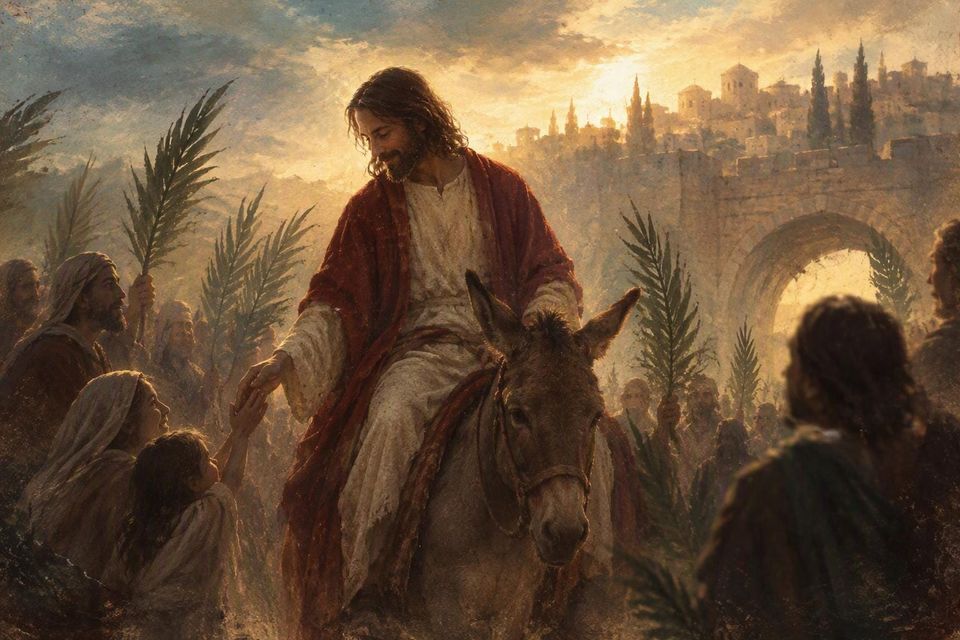
And notice what happens immediately after he tells this story: Jesus turns and walks into Jerusalem.
He doesn't ride in on a warhorse to execute his opponents like Archelaus. He rides in on a humble donkey–fulfilling Zechariah’s prophecy (Zech 9:9; John 12:14-15). He doesn't slaughter his enemies; he allows himself to be whipped, tortured, and executed for them. He offers his very life on the cross. That is the exact opposite of the king in Luke 19. John quotes the prophet Zechariah in the twelfth chapter, verse 15, “Don’t be afraid, people of Jerusalem. Look, your King is coming, riding on a donkey’s colt.”
Don’t be afraid.
Earthly kings rule by fear, threat, and abandonment. But Jesus tells us, "I will not leave you as orphans” (John 14:18). He sends his gentle, life-giving Spirit to dwell inside us. Unlike the servants in Luke 19, we are not left to figure things out on our own, fearfully trying to make sure we produce enough for a harsh king. John reminds us, "There is no fear in love. But perfect love drives out fear, because fear has to do with punishment. The one who fears is not made perfect in love (1 John 4:18).
The Life of the Branch
This is why the image of the Vine in John 15 soothes our bodies like a calming aroma of lavender to our anxious nerves.
Think about it: Is a branch under a heavy "responsibility" to bear apples?
Does it bear apples because it has a moral duty to bear apples?
Does the Vine stand over the branch and say, "Do your job. I’m leaving and will come back. It's all up to you while I’m gone"?
Never.
The Vine simply cares for the branch. It grounds it, holds it, and supplies it with continuous nourishment. In that safe, uninterrupted relationship, there is connection and flow. And then it happens: the apples emerge quietly out of that togetherness. Likewise, Isaiah gives us a beautiful image of how the earth receives the rain and snow from heaven and gives seed to the sower and bread to the eater. It is a gift—not a heavy-loaded responsibility.
As the rain and the snow
come down from heaven,
and do not return to it
without watering the earth
and making it bud and flourish,
so that it yields seed for the sower and bread for the eater,
so is my word that goes out from my mouth:
It will not return to me empty,
but will accomplish what I desire
and achieve the purpose for which I sent it. (Isaiah 55:10-11)
We have been reading Luke 19 in a way that turns a loving, generous God into a ruthless world leader. But Jesus’ point was the exact opposite. He is showing us what he is not like—so that we can stop living in the paralysis of fear, step out from under the weight of performance, and simply abide in the gentle, abiding flow of his love.
Member discussion