The Mute Gospel: Grief on the Edge of Testimony
“The Spirit of the Lord is upon me,
because he has anointed me
to bring good news to the poor.
He has sent me to proclaim release to the captives
and recovery of sight to the blind,
to let the oppressed go free,
to proclaim the year of the Lord’s favor.”
—Luke 4:18–19
Truth was never meant to whisper. It was meant to set the captives free. When Jesus stood in the synagogue and read from the scroll of Isaiah, he did not say someday—he said today. He proclaimed that the Spirit of the Lord was upon him to bring good news to the poor, release to the captives, sight to the blind, and freedom to the oppressed. It was not a message of eventual change, but a declaration that the season had already begun—the year of the Lord’s favor was now. But in many corners of the church, this same truth is asked to quiet down—for the sake of unity, for the comfort of the room, for fear of seeming divisive. We name this gentleness. We call it peace. But when unity becomes the standard by which truth is measured, we begin to hear the rocks cry their woes from the shadows: The Mute Gospel.
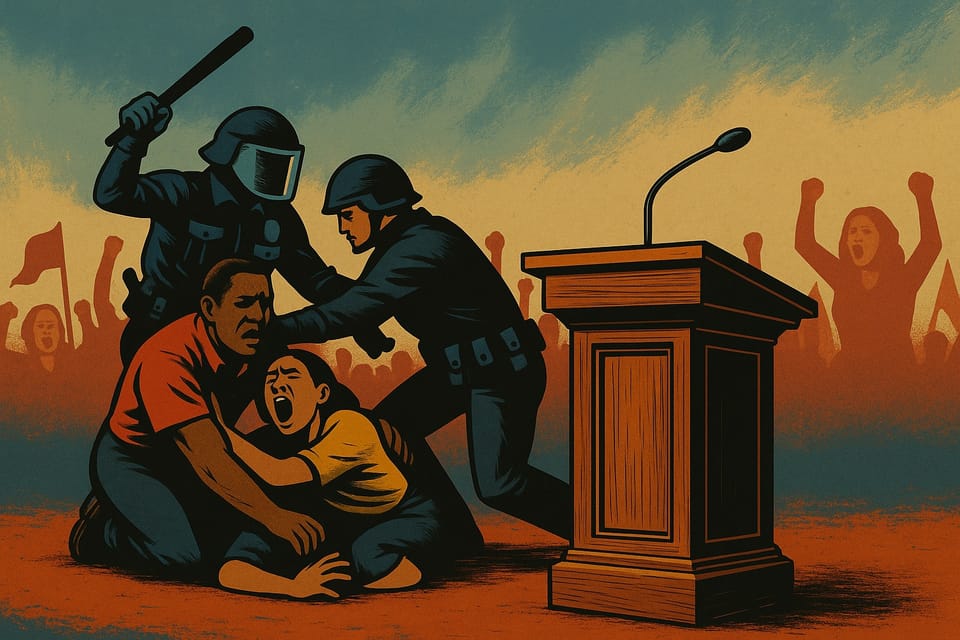
In that silence, injustice goes unchallenged. In that calm, the wounds of the world deepen. This is not peace—it is suffocation. And yet this silence is not accidental. It has been theologically sanctioned. A gospel that stays mute in the face of injustice has become a refuge for many Christians—particularly moderates in democratic societies—who persistently avoid the discomfort of confrontation. This gospel tells us that Jesus was above politics, that naming systems of harm is divisive, and that the church’s role is to offer comfort, not challenge.
The verse most often invoked is Jesus’ statement to Pilate: “My kingdom is not of this world.” But if you’ve ever raised your voice about deportations, the defunding of USAID programs that feed children dying of malnutrition, the humanitarian crisis in Gaza, the corruption of the American prison system, or the ongoing police brutality that steals Black lives—only to be told these concerns are worldly and not God’s priority—you know how painful that phrase can feel. It lands not as comfort, but as dismissal. As if God’s kingdom hovers aloof, detached from human suffering. But that interpretation severs the statement from the life that gave it meaning. Jesus did not float above the world. He walked straight into its wounds.
The Mute Gospel teaches us to step back. It baptizes our discomfort in holy-sounding restraint. It tells us that disengagement is discernment—that tone and timing matter more than truth—and that naming injustice is “too political,” while love must always look like harmony. What often goes unexamined, though, is that this muted posture does not exist in a vacuum. It functions as a passive accomplice to something far louder.
While one branch of the church remains hushed, another storms forward—wrapping conquest in sacred language. One withdraws; the other dominates. One muzzles truth for the sake of unity; the other weaponizes it for the sake of control. But both preserve the same broken order. Christian Nationalism asserts itself with coercion and spectacle. The Mute Gospel, by contrast, remains conspicuously absent when injustice flourishes—especially when that injustice benefits those at the center. Both distort the way of Christ. And both stand in stark contrast to the public, embodied, justice-centered ministry of Jesus.
This theology of withdrawal is not new. The Mute Gospel has long offered the church a place to hide from moral accountability—especially in times of social upheaval. In the antebellum South, it cloaked itself in the language of divine order. Presbyterian minister James Henley Thornwell argued that slavery was part of God's ordained hierarchy, writing in 1850: “The parties in this conflict are not merely abolitionists and slaveholders—they are atheists, socialists, communists, red republicans, Jacobins on the one side, and the friends of order and regulated freedom on the other” (see The Rights and the Duties of Masters). In pulpits across the Confederacy, salvation was preached even as human bondage was sanctified.
During the Civil Rights era, the same theology shifted its form—less overt, but no less complicit. Many white pastors counseled moderation, delay, and silence in the name of Christian unity. Martin Luther King Jr., in his 1963 Letter from Birmingham Jail, condemned this posture: “I have almost reached the regrettable conclusion that the Negro’s great stumbling block in his stride toward freedom is not the White Citizen’s Council or the Ku Klux Klanner, but the white moderate… who prefers a negative peace which is the absence of tension to a positive peace which is the presence of justice.”
Rather than champion King, many white evangelical leaders sought to discredit him. Some labeled him a communist; others refused to support his marches; many more chose silence over solidarity. King lamented, “There has never been a solid, unified, and determined thrust to make justice a reality by the American white church.”
In matters of gender, the same logic is applied within evangelical households. Submission is not just a personal virtue—it is cast as a spiritual duty. Southern Baptist leader Paige Patterson, a major figure in the denomination’s conservative resurgence, implied that wives should endure abuse rather than separate. In a sermon from 2000, he recalled counseling a woman to stay in her marriage despite violence. She returned with two black eyes—but, as Patterson proudly noted, her husband had begun attending church. This story, which sparked widespread outrage, was later cited in reporting on Patterson’s removal from Southwestern Baptist Theological Seminary in 2018, as covered by NPR
Patriarchy doesn't only thrive in the church because it is preached—it endures because it is protected by silence. In 2023, the Southern Baptist Convention expelled several churches, including Saddleback Church, for appointing women to pastoral roles—underscoring a theological system where gender hierarchy is enforced not just in belief, but in policy (New Yorker, 2025). In many congregations, women who questioned this hierarchy were labeled divisive, rebellious, or out of step with “biblical order.” The silence ran deeper in contexts of harm. In 2017, over 140 evangelical women launched the #SilenceIsNotSpiritual campaign, calling on churches to break their silence about violence against women and to take active responsibility for healing and protection (NCR, 2017). Their call revealed what many already knew: that silence was not passive—it was complicity. Purity culture and complementarian theology has created conditions in which women are often told to stay quiet about abuse or to submit for the sake of their witness. As one article described, the Southern Baptist Convention’s long-standing embrace of these teachings contributed to a culture that silences women, particularly in cases of sexual harm (Religion News Service, 2022). This is what it means to mute the gospel. To protect order while the wounded are asked to keep the peace. To guard reputation while injustice festers beneath the surface.
Historian Kristin Kobes Du Mez documents the broader scaffolding of this theology in Jesus and John Wayne, showing how evangelicalism fuses gender hierarchy, militant masculinity, and divine sanction into a single cultural force. R. Marie Griffith, in God’s Daughters: Evangelical Women and the Power of Submission, further illustrates how evangelical women are praised not for flourishing, but for their capacity to endure—suffering reframed as sanctification.
And today, The Mute Gospel continues—not as the twin of Christian Nationalism, but as its enabler. While one faction storms the halls of power in God's name, another sits quietly in the pews, claiming neutrality as virtue.
Influential voices like Leith Anderson, former president of the National Association of Evangelicals, promoted political restraint in the name of unity—but this often functioned as avoidance at moments when prophetic voice was most needed (The Atlantic, 2019). Billy Graham, though revered by many, made a principled decision to avoid endorsing political candidates. That choice, while rooted in humility, inadvertently modeled a posture of withdrawal that others would later adopt not from spiritual conviction, but from fear.
When Graham was criticized for failing to publicly condemn human rights abuses during his Cold War-era visit to the Soviet Union, one detractor accused him of setting the church back fifty years. Graham replied, “I am deeply ashamed. I have been trying very hard to set the church back 2,000 years.” Intended as a defense of timeless gospel priorities, the quote has since become emblematic of a view that recasts moral silence as spiritual fidelity (Becoming Bridge Builders, 2018).
In each case, the desire to remain “above politics” may begin with sincerity—even with a longing for spiritual integrity. But it too often ends in irrelevance or complicity. The refusal to engage becomes a kind of permission slip, allowing injustice to move forward unopposed. Whether through the assertive force of Christian Nationalism or the muted posture of conflict-avoidant faith, the prophetic call of the gospel is quieted in favor of comfort, control, or convenience.
If the Mute Gospel withdraws in the name of false peace, and Christian Nationalism storms forward in the name of false power, then the way of Jesus stands in radical contrast to both. His ministry does not seek control, nor does it retreat from conflict. Instead, Jesus reveals a kingdom that moves through the world with truth-telling love—one that neither flatters the powerful nor abandons the suffering. In him, grace and truth are not opposites but inseparable (John 1:14). He embodies a courage that heals and a presence that confronts—always rooted in the liberating heart of God.
Jesus’ statement to Pilate—“My kingdom is not of this world” (John 18:36)—must be heard in the context where it was spoken: not in private contemplation, but in public confrontation. He was standing before imperial power, under threat of execution—not retreating into abstraction, but exposing the limits of earthly rule. His words were never meant to dismiss the realities of this world, but to declare that his authority does not arise from its corrupt systems. And yet, his kingdom moves into those very systems with unflinching moral clarity—bringing healing, disruption, and liberation wherever domination has taken root (Luke 4:18–19; Matthew 23:23–24).
Jesus’ entire ministry bore witness to this. He did not turn away from the world’s brokenness—he stepped directly into it. He healed bodies rendered untouchable by purity laws (Mark 1:40–42). He spoke with women, foreigners, and the poor in ways that shattered both religious and cultural barriers (John 4:7–26; Luke 7:36–50; Luke 10:25–37). He publicly challenged exploitative systems, overturned tables in the temple (Matthew 21:12–13), and pronounced woes upon leaders who used their power to crush the vulnerable (Matthew 23:13–36).
His presence disrupted. His kingdom confronted. Not with weapons, but with a kind of love so grounded, so just, so unwilling to collude with false peace, that it threatened both religious and political establishments. His kingdom was not from this world—but it was deeply for it.
This was the fire that ignited the early Church. It bore witness with courage in the face of empire. The Spirit did not descend at Pentecost to mute the Church’s voice—it came to fill it with holy fire and send it into the world (Acts 2:1–4). If the Church is to reclaim its prophetic voice, it must begin not by condemning its silence, but by bringing compassionate attention to the fear beneath it—the fear of losing friendship and familiarity, of disrupting harmony, of being cast out for naming harm. For many, silence has served as a shield—protecting a sense of self as a “Good Christian,” preserving group belonging, avoiding the overwhelm of difference. These fears are not trivial; they are tender. They guard something sacred: the human need to belong, to feel safe, to be seen as faithful. But when that protection hardens into avoidance, and silence becomes our sanctuary, truth has nowhere to dwell.
There is a reason we’ve fallen silent—not merely from cowardice, but from experience. The Church has seen what happens when people speak with conviction in unjust times. Again and again, those who carry moral clarity have been portrayed not as faithful, but as fanatical—not as prophets, but as problems. Throughout history, truth-tellers have been cast as unhinged ideologues, insurrectionists, or enemies of God’s order. Their witness has been dismissed as madness, their courage reframed as danger. In such a world, silence becomes a form of survival—a way to avoid the distortion that so often greets the voice of love when it confronts power. And yet, it is precisely in this silence, born of injury and self-protection, that the invitation of Christ begins—not through force or shame, but through abiding.
To abide is to remain in the presence of Christ—to stand where we are, held in his gentleness, seen in his loving eye, forgiven even before we speak. It is here, in this gaze of mercy, that the Church can begin to unlearn the reflex of hiding. It is here that we are invited out of the shadow and into the light—not exposed for judgment, but revealed for healing. (John 15:4–5; 1 John 1:7)
The courage to bear witness does not come from trying harder. It comes from abiding longer. From standing still in the presence of the One who sees through our silence and still calls us beloved. This is how a Church reclaims its voice—not by rising in anger or rushing to prove itself, but by letting the light of grace uncover what has been buried.
And when we learn to stand there, with Christ, we become a people who can speak—not with superiority, but with tenderness. Not with fear, but with truth. A people whose words are shaped by the One who is full of grace and truth (John 1:14). A people who know that to bear witness is not to win a battle, but to stay present to love, even when it costs.
Abiding in Christ does not mean retreating from the world. It means being rooted deeply enough in his presence to speak without fear. Silence may have once served as protection—but as we abide, we are strengthened to become witnesses. Not because we are unafraid, but because we are anchored. The voice that rises from abiding is not performative or harsh—it is clear, grounded, and true. And this is the voice the world needs now.
The Mute Gospel has taught us to confuse stillness with faithfulness, and neutrality with wisdom. But Jesus never called his followers to be neutral. He called them to be witnesses (Acts 1:8). A witness is not merely someone who believes, but someone who shows up. Someone who risks being seen. Someone who tells the truth—not because it will be received, but because it is real. Like the prophets before them, the early apostles spoke not for applause but for alignment with the heart of God (Jeremiah 20:9; Acts 4:19–20).
To bear witness in this time means refusing the comforts of disengagement. It means breaking the silence when immigrants are scapegoated (Exodus 23:9), when Black lives are treated as expendable (Genesis 1:27; Amos 5:24), when queer and trans youth are vilified in the name of “family values” (Galatians 3:28). It means confronting the ways our churches, through inaction or soft complicity, become chaplains to empire rather than vessels of Christ’s liberating presence (Matthew 23:23; Revelation 3:15–16).
And it means reclaiming a gospel that is both spiritual and social. The early Church did not grow through silence. It grew because it embodied an alternative way of being—breaking bread across dividing lines (Acts 2:46), sharing resources radically (Acts 4:32–35), standing in solidarity with the oppressed (James 2:1–9). Their allegiance was to a kingdom not of this world—but unmistakably for its healing.
Much of the modern Church has been shaped by a one-dimensional gospel—one that focuses on personal salvation, internal repentance, and private piety. It trains us to examine ourselves, to confess, to seek purity of heart (Psalm 51:10). These are not wrong—but they are incomplete. They become distortions when they stop at the self.
This is a gospel that teaches us to pray for peace, but not to make it—forgetting that Jesus said, “Blessed are the peacemakers,” not the peacekeepers (Matthew 5:9). It invites us to confess sins of the heart while ignoring the sins of the system. To feel burdened by personal failures, yet untouched by the public wounds of our neighbors. It tells us the work of faith is about becoming better people, not about becoming braver ones.
But the gospel of Jesus was never only about inward change. It was about outward liberation. It was good news for the poor, release for the captives, sight for the blind, and freedom for the oppressed (Luke 4:18–19). That is not metaphor. That is movement. That is action. That is justice.
God has never asked his people to fast from food while feasting on injustice. “Is not this the kind of fasting I have chosen,” says the Lord, “to loose the chains of injustice and untie the cords of the yoke, to set the oppressed free and break every yoke?” (Isaiah 58:6).
To repent without repair, to seek sanctification while others are crushed, to study Scripture while ignoring the cries of the world—that is not holiness. That is withdrawal masquerading as devotion. A gospel that stops at the mirror has forgotten the second great commandment: “You shall love your neighbor as yourself.” (Mark 12:31). Love that stays inside is not love—it is fear wearing a spiritual disguise.
Let the Woe Be Heard
There are times when what’s wrong in the world doesn’t need to be explained—it needs to be felt. Jesus didn’t just teach truth. He ached it. He cried out “Woe to you” not to punish, but because something had gone so far off course, it hurt to witness it. That sorrow was his witness—a voice raised not in rage, but in grief that refused to stay quiet (Matthew 23).
But today, the Church too often turns away from that grief. It numbs. It retreats into curated silence. It scrolls past headlines that should pierce the soul. It avoids the news—not just out of fatigue, but out of fear that letting the pain in might change something. And it would. It is grief on the edge of testimony.
The woe is everywhere.
In the deportations tearing families apart.
In policies that strip trans youth of safety and recognition.
In rising authoritarian rhetoric cloaked in religious language.
In the erasure of racial history, the criminalization of protest, the quiet sabotage of voting rights.
In the humanitarian crisis in Gaza—where the suffering is immense, and grief itself is often silenced under accusations of antisemitism.
These are not political talking points. These are people. Image-bearers of God. And if the Church cannot feel the weight of these things, it is not apolitical—it is disconnected from the heart of Christ.
Woe to the silence that protects power. Woe to the unity that costs the vulnerable their belonging. Woe to the gospel that hides behind mirrors, yet refuses to face the street.These are not condemnations. They are grief becoming voice. They are love refusing to pretend everything is fine.
This is where the Church must return—not to moral panic or performative outrage, but to presence. To a sorrow that stays. To witness that costs. Because maybe the most faithful witness isn’t louder—but closer. Not shouted, but seen. To let the woe in.
And let it speak.
Member discussion