The Weavers’ Circle: Threads That Hold Us All
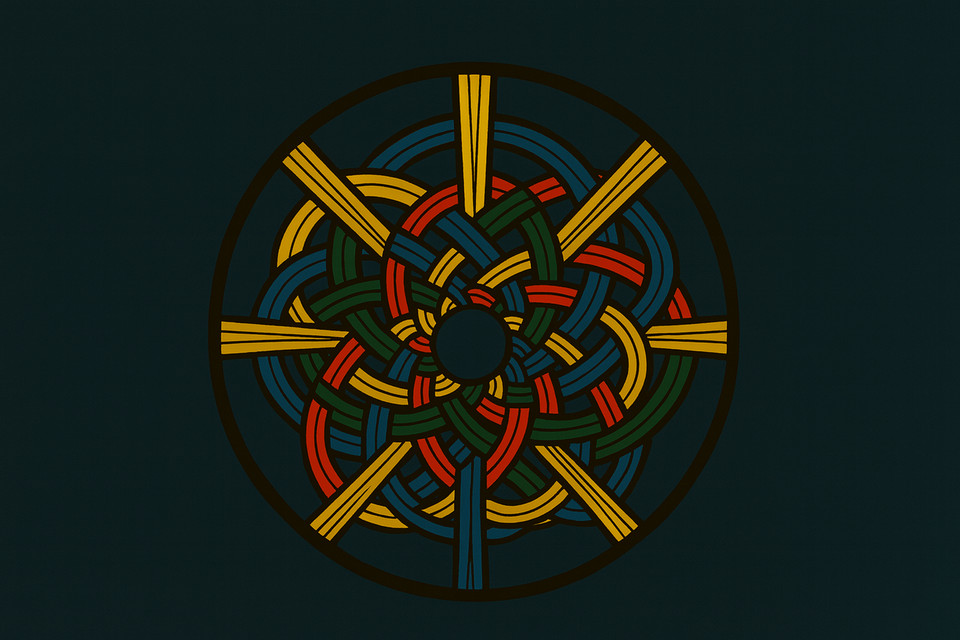
Imagine this with me: a circle, not a stage.
We sit, threads in hand.
One by one, we bind what has been torn.
We listen.
We keep listening—until every voice has weight.
Only then does the fabric hold,
only then is it strong enough to carry us all.
And if one thread is missing, if one truth is dismissed,
the weave loosens,
violence slips in,
and desperation takes its place at the table.
If we truly want to turn this democracy from fragile civility into something that flourishes—if we want to cultivate peace and escape the political violence that has scarred us—we cannot content ourselves with the low bar of “learning to disagree.”
Much of my daily professional life involves direct encounters with victims of psychological and emotional harm. I provide therapeutic space for healing processes to occur within relational contours, holding space for movement and acknowledgement of what hurts. I feel a responsibility to respond to comments made by a governing official in the aftermath of the Charlie Kirk assassination: he stated, “Words are not violence. Violence is violence.”
When I heard that I immediately felt something tighten internally and bristle at wounds cut by verbal and emotional abuse now being dismissed, called nonviolent because they are not physical. Something in that statement was minimizing the pain that is real, measurable, and scientifically documented. Not that this alone gives it credibility—it is felt in the body.
Nevertheless, for me to have this reaction is not a denial of physical violence and the need for it to be prosecuted. It is me widening the lens to enable myself to acknowledge violence in all its forms.
Neuroimaging shows that exposure to parental verbal aggression is linked to harmful brain changes. Choi et al. (2009) found reduced white matter integrity in the arcuate fasciculus, a tract connecting regions essential for language and emotion regulation. Tomoda et al. (2011) reported structural alterations in the left superior temporal gyrus, a language-processing area, interpreted as abnormal development under toxic stress. More broadly, Teicher & Samson (2016) found that emotional maltreatment alters the prefrontal cortex, temporal lobes, and corpus callosum—regions critical for managing threat and regulating emotion.
Clinically, emotional abuse is linked to PTSD symptoms every bit as severe as those following physical or sexual abuse. In fact, emotional abuse is sometimes more strongly correlated with intrusion, hypervigilance, and negative mood symptoms than physical abuse (Hoeboer et al., 2021). Emotional abuse is also among the most prevalent forms of maltreatment worldwide, associated with depression, anxiety, and relational difficulties across the lifespan (Gama et al., 2021).
This is not just about childhood. The same wounds show up in adulthood, often in racialized forms. Accomplished Black women are dismissed as “affirmative action hires.” The Olympic athlete Simone Biles was shamed for protecting her health. The Civil Rights Movement is maligned as a mistake. Some critics drag forward the personal conduct of civil rights leader Dr. Martin Luther King Jr. as though exposing weakness could erase the demands of his dream.
These are not just words; they are wounds that delegitimize and diminish whole communities. Research confirms what those communities already know in their bodies: racial slurs and hostile speech trigger physiological stress responses—what one study called “lexical mini-slaps in the face.” Exposure to slurs has been shown to predict PTSD and depression (Wypych & Bilewicz, 2024). Derald Wing Sue’s work on microaggressions demonstrates how “everyday indignities” accumulate, embedding trauma in the nervous system.
And the jeopardy runs deeper still: naming these patterns is increasingly framed as dangerous. Truth-tellers—especially voices of color—are cast as threats. Speaking out against systemic racism and microaggression is equated with incitement. This weaponization of “safety” language does not protect the vulnerable; it shields the powerful from accountability and deprives us all of the critique we need to grow. The truth must be told:
Not all wounds bleed.
Some settle in the marrow.
Some etch themselves into the wiring of the brain.
We carry them, unseen.
And when we gather, those hidden wounds shape the circle too.
Democracy is not cheap. Our common life requires more than cooling tempers into verbal sparring matches to see who wins and who loses. That framework is bankrupt. The “marketplace of ideas” pits us against each other as competitors, but a real democracy is not built on competition—it is woven together.
Here’s where the pragmatist tradition is both helpful and limited. William James and Charles Peirce argued that the truth of a belief can be seen in its consequences. That insight matters. But too often it gets flattened into: don’t trust what you feel inside, just look at the results outside. The problem is that the “outside” is never neutral—it is shaped by power, by which voices and methods get to count as legitimate evidence. Whole swaths of human truth go untested because the experiment is never run.
Eugene Gendlin pushed this conversation forward by reminding us that the body itself is a source of truth. What happens in us—tightness, openness, heaviness, relief—isn’t just private feeling; it is the body registering reality. Our inner life is not a vacuum. It’s an open system, constantly taking in the world around us, carrying its marks and impressions. Ignoring this is not pragmatism—it’s blindness to the most immediate consequences of how we live together.
If we reduce truth only to what can be measured in debates, institutions, or statistics, we reinforce the very exclusions we say we oppose. But if we honor both bone truths—science, fact, evidence—and soft-tissue truths—the body’s lived witness of anxiety, longing, hope, conscience, anger—then democracy can breathe.
A flourishing democracy requires more than the absence of harm. It requires the presence of care, dignity, and belonging—for all people, not only citizens, but every person by virtue of their humanity. Violence cannot build democracy. It destroys trust, deepens wounds, and silences the very truths we most need to hear—the truths that could weave belonging.
In a true democracy, we take our seats in a weavers’ circle. We work to bind what is torn, listening until each voice has weight, weaving together a fabric strong enough to hold us all. Every member must feel that their lived experience matters, that their rights and voices shape society. Without that, exclusion breeds desperation.
This is where empathy becomes indispensable. To sit in such a circle is to recognize a space I occupy but cannot fully define. Others join me and add their truth to mine. My interpretations are only part of the story. I alone don’t make the circle complete and whole. Empathy is the practice of letting those threads in. Without it, integrity stiffens into something fragile—an “I” sealed off, afraid that to yield is to dissolve. That is the fear underneath the current threat to our democracy.
It is a fragile sense of Me and My Worldview. That must win, we say. And that is the stage of our current civic discourse—debate and spar for the next viral feed. We make our encounters empty and hollow this way.
Marshall Rosenberg’s work on Nonviolent Communication shows how empathy can move us beyond defensiveness and attack. His simple framework—observing without judgment, naming feelings, identifying underlying needs, and making requests instead of demands—creates conditions where conflict does not have to collapse into winners and losers.
Integrity that cannot bend will break. Threads pulled too tight will snap. But when each color gives a little, the fabric holds.
Strength is not in the shell. It is in the weave.
Closed-off integrity says: I can remain intact only if I keep your truth out.
Relational integrity trusts: I remain whole as I let your truth in, because integrity is proven in relation, not isolation.
This is why empathy is power-sharing. It does not erase the self; it proves the self durable enough to stay present while others bring their truths. Each thread keeps its color, but the weave holds only when threads cross. Without empathy, democracy unravels into isolated strands.
And here we must pause. Many today look to institutions and systems as the main targets for change. Their critiques matter—laws, policies, and hierarchies shape what is possible for every life. But the work of the Weaver’s Circle begins somewhere more elemental. It starts with being alive together—with breath, with feeling, with the mystery of two nervous systems meeting in real time.
To participate in a weavers’ circle means refusing to reduce people into structures to be corrected or positioning them within an argument. It means meeting them as moving, sensing beings whose meanings shift moment by moment. Change then grows through the space between breaths, through resonance and reflection, through silence that makes room for what has not yet found words.
The circle is not a place for bullhorns or blueprints. It is a space for listening until what is real begins to speak. Structural reform has its place, but when our encounters are reduced to tactics or performance, the soul of democracy dries out. The weave depends on presence—on eyes meeting across the fabric, on each thread remembering the life in the others.
If we commit to weaving threads of personal truths together, this cannot be reduced to a stage for winning. For those on the margins, lives are at stake. It is not a match of opinions; it must be held as a sacred conversation. Indigenous traditions have long practiced such sacred peacemaking circles (Pranis, 2005).
Robert Jones Jr. captures the gravity of this work:
“We can disagree and still love each other, unless your disagreement is rooted in my oppression and denial of my humanity and right to exist.”
This is where we are losing our way. And I am not immune—I too at times feel the impulse to impose the framing of a wrestling match that rewards who can best weaponize the facts and rhetorical savvy to take down opponents for spectacle. We get an instant shot of superiority that feels like proof we are right. But when winning becomes the goal, we stop sitting with each other. We stop sitting with truth that matters. We lose the possibility of power-sharing, and that is what democracy is.
So we must pause and take our bearings. We must notice the contortions within us: distortions of freedom, habits of exclusion, reflexes of dismissal, racing at speeds driven by models of efficiency. Freedom must not mean punishing those who live from other identities, beliefs, or ways of loving.
True democracy cannot trample dignity, deny historical harm, or erect new gatekeepers of belonging. Diversity without wholeness is broken lives scattered—albeit colorfully—on the debate floor. Wholeness with difference is what some faith traditions name shalom—a peace deeper than calm, one that comes through facing injustice and repairing what is torn.
This peace is not the absence of conflict, not the cheap harmony of avoidance. It is the hard-won peace that comes only from facing injustice without flinching.
Maybe you feel it with me now. Something invites.
The circle waits.
Empty chairs ask for the missing voices.
We can choose:
keep the fabric frayed,
or pick up the torn threads
and begin again.
Peace does not come finished.
It is woven, slowly, together.
If we accept the relational challenge before us, the road ahead will not be easy. It will ask humility from the powerful, resilience from the weary, and courage from us all. There are those from faith traditions who have heard this calling best in the words, “Blessed are the meek, for they will inherit the earth” (Matthew 5:5).
That is to say—it is worth it, because a democracy that only renounces violence stops short. A democracy that listens deeply, honors both bone and soft-tissue truths, follows pain as compass, and protects dignity—that is a democracy that can flourish.
So let us pause. Let us reimagine. Let us listen with empathy, presence, and courage. Let us sit together in a weavers’ circle, binding together what has been torn, and build a common life where every voice belongs, every truth matters, and every person has room to live, heal, and thrive.
References
Choi, J., Jeong, B., Rohan, M. L., Polcari, A. M., & Teicher, M. H. (2009). Preliminary evidence for white matter tract abnormalities in young adults exposed to parental verbal abuse. Biological Psychiatry, 65(3), 227–234.
Gama, C. S., Mendlowicz, M. V., Braga, R. J., Figueira, I., & Wang, Y. P. (2021). Emotional abuse and its impact on mental health: A global perspective. Psychiatry Research, 304, 114125.
Gendlin, E. T. (1981). Focusing. Bantam Books.
Hoeboer, C. M., de Roos, C., van Son, G. E., Spinhoven, P., & Elzinga, B. M. (2021). The differential impact of emotional abuse and physical abuse on PTSD symptoms and the role of relational support. Child Abuse & Neglect, 117, 105093.
Pranis, K. (2005). The Little Book of Circle Processes: A New/Old Approach to Peacemaking. Good Books.
Rosenberg, M. B. (2003). Nonviolent Communication: A Language of Life (2nd ed.). PuddleDancer Press.
Sue, D. W. (2010). Microaggressions in Everyday Life: Race, Gender, and Sexual Orientation. Wiley.
Teicher, M. H., & Samson, J. A. (2016). Enduring neurobiological effects of childhood abuse and neglect. Nature Reviews Neuroscience, 17(10), 652–666.
Tomoda, A., Suzuki, H., Rabi, K., Sheu, Y.-S., Polcari, A., & Teicher, M. H. (2011). Exposure to parental verbal abuse is associated with increased gray matter volume in superior temporal gyrus. NeuroImage, 54(Suppl 1), S280–S286.
Wypych, M., & Bilewicz, M. (2024). The trauma of verbal violence: Psychological and physiological effects of ethnic slurs. Journal of Social Issues, 80(1), 145–166.
Member discussion